 PROJECTXPLORE
HMS Bayano
An armed merchant cruiser, torpedoed and sunk by German submarine U-27 on 11 March 1915, which sits at a depth of 106m in the North Channel between Northern Ireland and Scotland.
The identification.
On 12 October 2025, ProjectXplore divers, supported by skipper Richard Lafferty and crew Timmy Donaghy on board the dive charter MV Aquaholics 5, successfully identified the wreck of HMS Bayano, at a depth of 106m in the North Channel between Northern Ireland and Scotland. On 12 October 2025, the team surveyed the site using a towed side scan sonar (SSS). Subsequently, on 12 and 13 October 2025, the team documented the site.
The wreck of HMS Bayano sits in 106m, with a least depth of 84m, lying bow NNW / stern SSE, with a 20-degree list to starboard. In places, the wreck rises over 15 metres high from the seabed. Much of her superstructure is still in place above her.
What we documented.
We are confident that we have conclusively identified the wreck as HMS Bayano, on the basis that she remains the only British Armed Merchant Cruiser ("AMC") from the First World War sunk in the North Channel with an armament of 6" (152mm) guns. No other British AMC from the First World War was sunk in the North Channel with this type of armament.
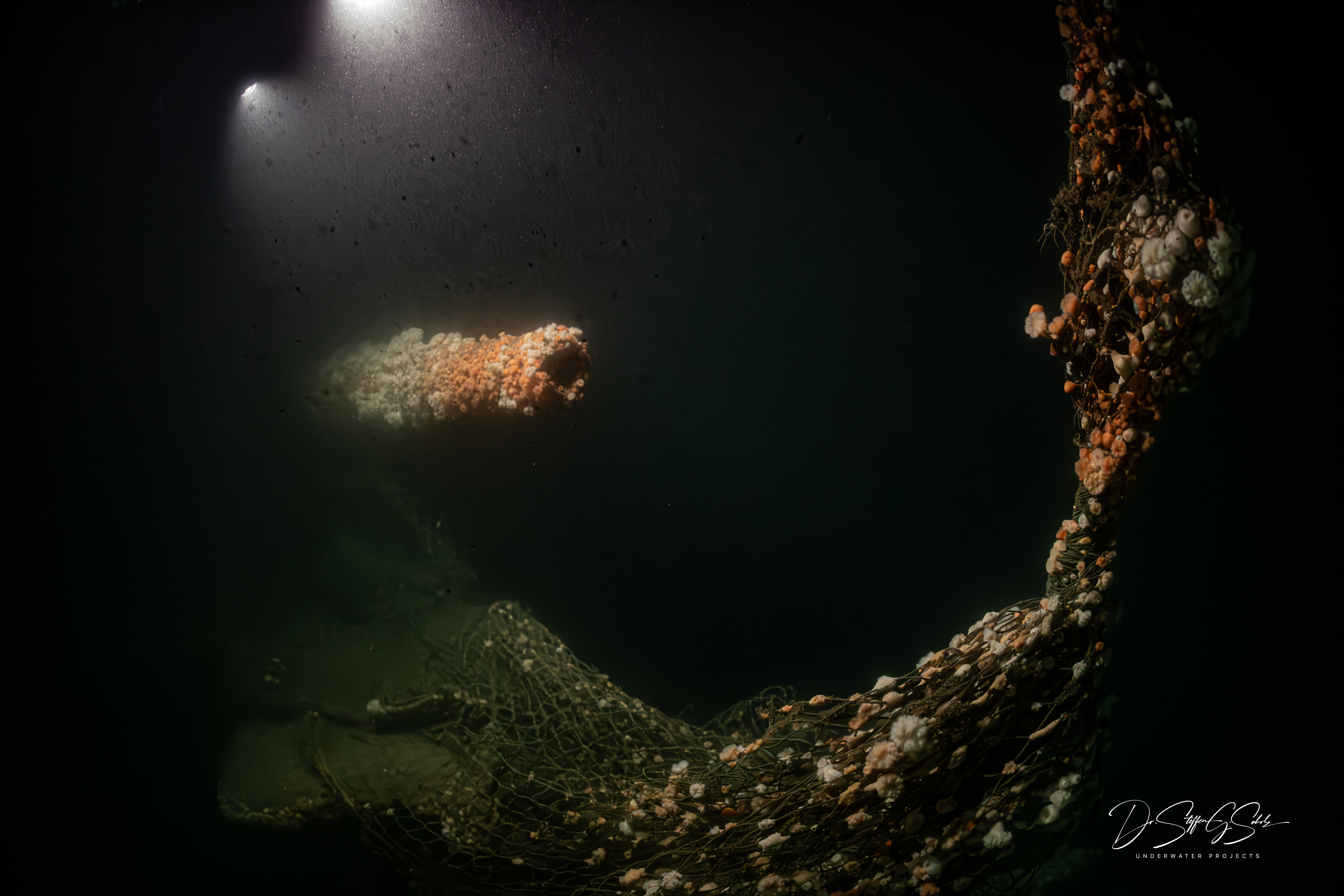
Two of the 6-inch guns were photographed, one on the forward starboard rail and one on the centre line of the stern, confirming her conversion from a merchant ship to an AMC. We also measured and photographed the internal diameter of the muzzle of the 6" gun at the stern. Furthermore, the barrel length was confirmed via sonar to measure 6.3m as expected for a Mark 1 QF 6-inch central pivot naval gun.
In addition, we located the following features that reinforce the identification:
- Machinery consistent with early 20th-century refrigeration systems was identified, including insulated piping and compressor remnants, evidence of the ship's pre-war service as a refrigerated fruit carrier.
- The forecastle 6-inch gun remained on the starboard rail, as reported by Johnny Caulfield, the 20-year-old reservist on look-out duty when U-27's torpedo struck ("I was on look-out duty under the bridge at the time, when there was a fearful crash … Almost instantly the gun on the forecastle went over the side.").
- The bridge foundation and funnel base were identified amidships, confirming the single-funnel layout typical of Alexander Stephen & Sons designs. Two masts were documented, one forward and one aft, both collapsed onto the deck.
- We found the distinctive 5-bar safety railings on the promenade deck parallel with the gunwales outside the companionway as per the photographs here in the report.
- The well-preserved stern section showed the vessel's characteristic elliptical transom profile. The hull's steel construction, riveted seams, and framing pattern matched Alexander Stephen & Sons merchant shipbuilding methods.
- The vessel's dimensions matched the dimensions of HMS Bayano: 126m long and 16m beam confirmed via sonar.
- The pattern of damage on the seabed today closely matches reports of the circumstances of her loss. There was a clear break forward of the bridge at its largest on the starboard side, which matches reports from the Royal Marine, Arthur Craze, that U-27's torpedo struck "directly under the bridge on the starboard side, and the fore part of the ship seemed to be blown up".
- The location of the wreck sits just 1.7nm from the position indicated by Royal Marine, Private Arthur Craze, and 2.4nm from the position indicated by U-27's Kriegstagebuch ("KTB" or war diary) maintained by Kapitänleutnant Wegener.