 PROJECTXPLORE
HMS Nottingham
The last missing British light cruiser of the First World War, and veteran of battles at Heligoland Bight, Dogger Bank and Jutland, torpedoed and sunk by German submarine U-52 on 19 August 1916.
 by Leo Fielding
The discovery.
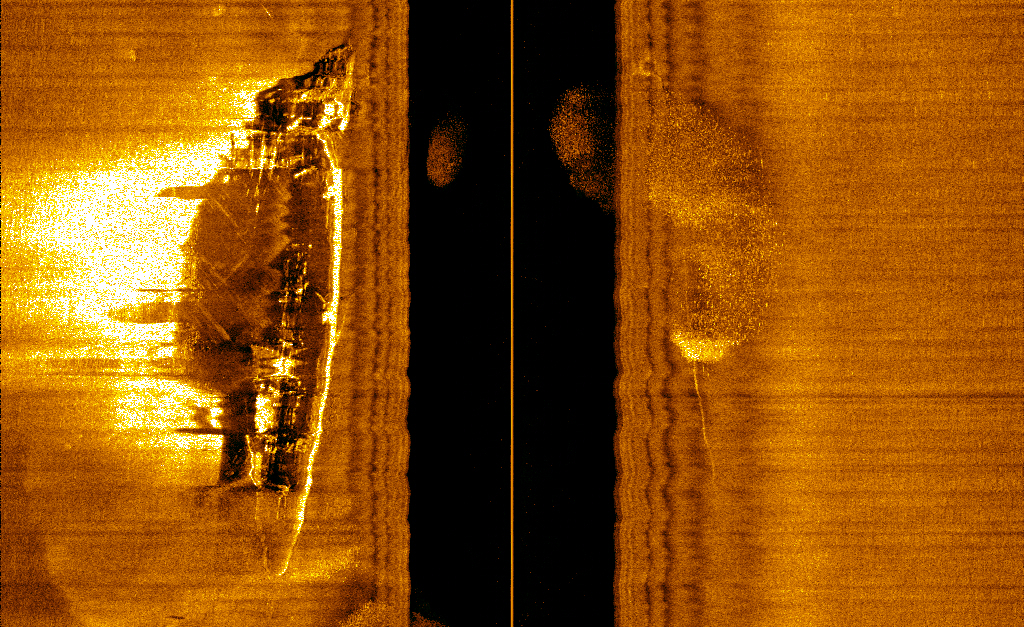
After eight months of preparation, on 22 April 2025, ProjectXplore divers, supported by skipper Iain Easingwood of MarineQuest on board the dive charter MV Jacob George, successfully discovered the wreck of HMS Nottingham, approximately 60 miles offshore in the North Sea. On 24 April 2025, further survey work was carried out using a towed side scan sonar, a down scanning sonar and a single-beam echo sounder. Subsequently, on 16 July 2025, ProjectXplore divers documented the site.
What we documented.
Based on the ship's name stamped across the top of the stern, her dimensions, main armament, anchor equipment, armour, propulsion and the fact that her condition on the seabed today closely matches reports of the circumstances of her loss, we are in no doubt that this is the wreck of HMS Nottingham. Our summary findings are as follows:
- HMS Nottingham today sits in 82m of water, lying bow north / stern south, with a 45-degree list to port, as expected from both British and German reports that she heeled to port. In places, the wreck rises 8 to 10 metres high from the seabed. Much of her superstructure is still in place above her.
- Her main armament of 9 x 6-inch guns with barrels measuring approximately 711cm in length remained in place: 2 on the forecastle, 2 amid-ships between the foremast and 1st funnel, 2 amid-ships between 3rd and 4th funnel, 2 aft of the mainmast, and 1 at the stern on the centre line.
- With the exception of the bow area, the wreck's state of preservation was excellent. The lettering is embossed 'NOTTINGHAM' across the top of the stern, next to a porthole looking into the Captain's day cabin. The wooden decking laid astern and amidships was still in place, with the davits lying across the deck.
- Her anchor equipment – comprising 3 Hawse pipes with 3 kedge anchors, 1 each on her port side and 2 each on her starboard side – was confirmed present. The 3 kedge anchors were on the seabed with the anchor chains fully paid out.
- On the port side behind the bridge, white plates were found stamped with a Royal Navy blue crown emblem, depicting alternating stern and sail motifs. The bridge itself had fallen forward and to port. The engine revolution telegraph on the bridge was located.
- Her four funnels with a distinctive appearance ("the characteristic thin:thick:thick:thin arrangement of the funnels of the 'Towns'") were located. Her dimensions were also confirmed via SSS imagery and GPS to match the dimensions of HMS Nottingham: 139m long x 15m beam.
- There was a clear break forward of the bridge at its largest on the port side. This matches reports that two of the torpedo explosions struck abreast her bridge on the port side, between watertight bulkheads No. 28 and No. 40.