 PROJECTXPLORE
HMS Tiger
The last missing British 30-knot torpedo boat destroyer sunk in the English Channel, cut in two by a collision with the 9,800-tonne armoured cruiser HMS Berwick during night manoeuvres on 2 April 1908.
The discovery.
An international team of British, German, Polish and Portuguese divers, working in partnership with Dave Wendes, skipper of the dive charter boat Wight Spirit, have successfully discovered, identified and documented both sections of the wreck of HMS Tiger, the last missing British 30-knot torpedo boat destroyer sunk in the English Channel, at a depth of 62m south of the Isle of Wight.
The search for Tiger had lasted nearly 4 years. On 11 April 2025, the team surveyed the site using a towed side scan sonar. However, it was not until further post-processing of the data in November 2025 that the team spotted the outline of the wreck. Subsequently, on 10 March 2026, the team re-scanned the site at higher resolution. On 23 and 24 June 2026, the team dived the stern section. And on 8 and 9 July 2026, the team dived the bow section. Finally, on 24 July 2026, the team surveyed the site using side scan sonar at high resolution.
What we documented.
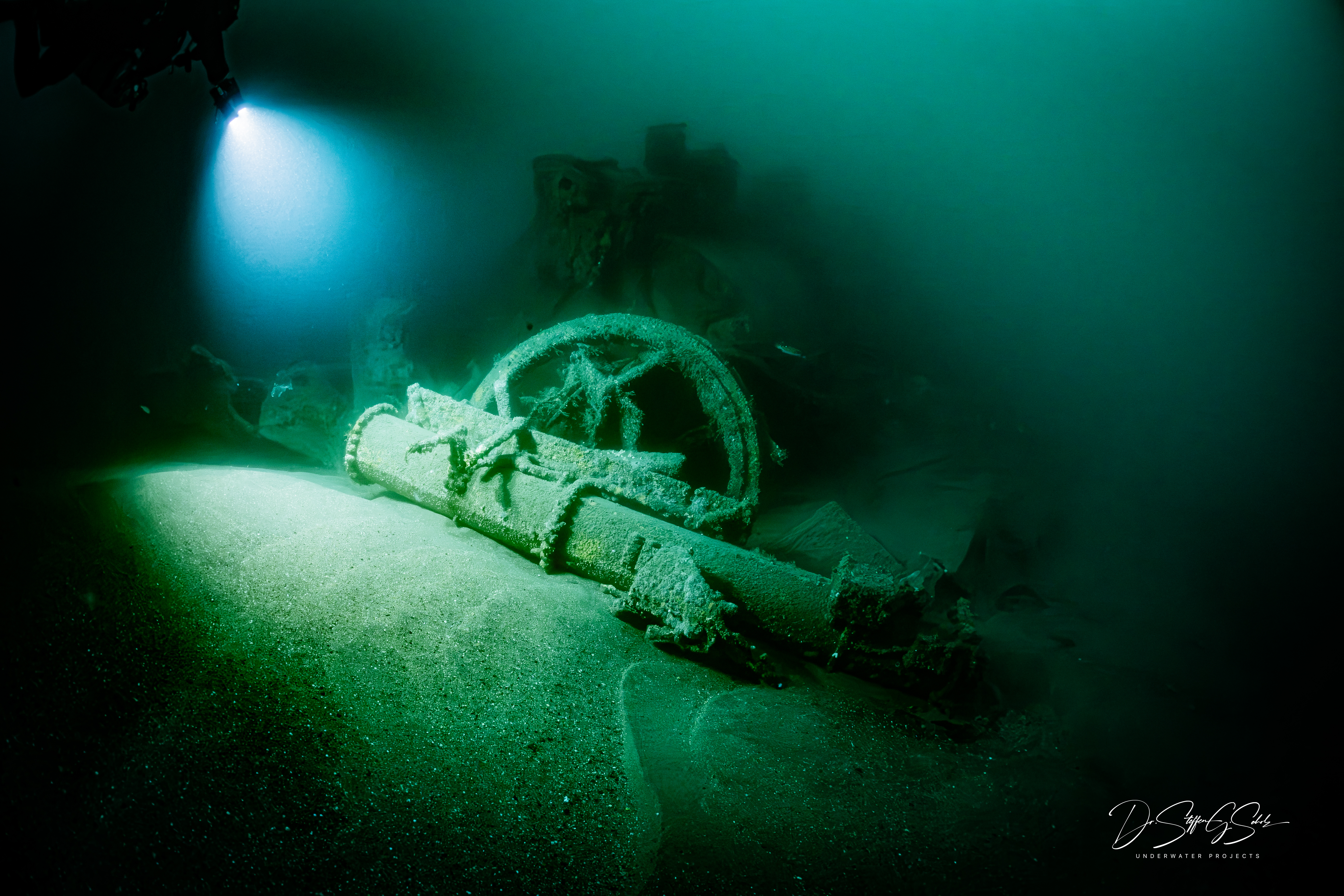
Tiger sits in 62m, with a least depth of 58m, in two sections, each measuring approximately 34m x 6m, approximately 140 metres apart. The stern section lies with a 20-to-30-degree list to port, on a sand and shingle seabed, stern to the NE (060°) and mid-ships to the SW (240°). The bow section lies with a 10-degree list to starboard, on a rock shelf of large boulders, bow to the NE (075°) and mid-ships to the SW (255°). In places, the wreckage rises over 4 metres from the seabed.
Documented features include (with reference to numbered compartments on the side profile plan for Tiger's sister ship, HMS Thorn):
- Two fully intact, deck-mounted stern and midships torpedo tubes, complete with slewing mechanisms to rotate the torpedo tube mounts independently of the ship's heading, in position as fitted at compartments 61 to 69 and 99 to 109.
- At least 2 x Mk1 Hotchkiss 6-pdr. 8cwt guns, in position either side of the bridge around compartments 32 and 53, with an internal barrel diameter measured to be 57mm (2.2 inches).
- Ammunition store with racks of 57mm (2.2 inch) diameter shells for a Mk1 Hotchkiss 6-pdr. 8cwt gun, plus other ammunition types.
- The mount for the 12-pdr. Q.F. (Quick Firing) 12 cwt. gun located in position around compartment number 25.
- A brass rectangular cast-metal plaque with raised lettering: "12 PDR SHELL RM", referencing the 12-pdr. shell room located in the hold between compartments 26 and 30 on the starboard side of Tiger.
- Racks of cartridge cases complete with primers and springs for the 12-pdr. gun with a rim diameter at the primer end measured to be approximately 100mm (3.9 inches).
- Mount with four legs for the 1 x stern Mk1 Hotchkiss 6-pdr. 8cwt gun in position, as fitted around compartments 119 to 121.
- The heads of 18-inch Whitehead torpedoes each with a threaded hole ("pistol socket") in the torpedo nose measuring approximately 55mm (2.1 inches) in diameter for fitting the "pistol" that triggered the main explosive charge.
Further features consistent with Tiger that reinforce the identification included:
- All of the four "Normand" boilers on Tiger with the distinctive three-drum design consisting of a steam drum above two water drums in a triangular layout, with water tubes filling in the two sides of the triangle.
- Four Dent & Co. London fluid compasses with 128-point graduated cards. The cards showed a fleur-de-lis pointing North with "Dent" visible through the glass. The pattern on the compass is known as pattern 20 and was made exclusively for the Admiralty from 1892 to 1907, consistent with Tiger's completion in 1901.
- The main ship's bell with the outline of the letters "HMS" visible on the shoulder of the bell, the other letters being obscured by heavy concretion.
- The starboard propeller, two of the blades, the hub, two support brackets for the propeller shaft, and part of the propeller shaft itself, plus a well-preserved rudder assembly, including rudder stock with L-shaped bearing housing matching those on plans for Tiger's sister ship Thorn as fitted.
- Davits for the 25-foot whaler as expected on the starboard side of the stern section in position as fitted around compartments 73 to 81.
- The vessel's total dimensions validated via GPS and side scan sonar matched the dimensions of Tiger: 67.6m (222ft) length overall x 6.25m (20ft 6in) beam. The break forward of the 4th Normand boiler matches reports that Tiger was struck by Berwick between funnels two and three.
The expedition had also contributed to the historical record regarding Tiger's final moments, including confirmation of the exact location of the impact with Berwick, and that based on her telegraph and rudder position indicator, Tiger had seemingly not reduced speed or altered course to avoid Berwick immediately prior to the impact.
"I've been diving and researching wrecks in the area since the 1980s, and along with some help from other divers, have positively located and identified numerous wrecks which were unknown or wrongly identified. To find the wreck of HMS Tiger, when I'm approaching the end of my chartering career, is a wonderful finale to all those years of diving and research, and I couldn't have finished on anything better. It rates as the absolute cream of the crop." — Dave Wendes, skipper of Wight Spirit